What Is Ratio Data? Survey Questions, Examples, and Analysis
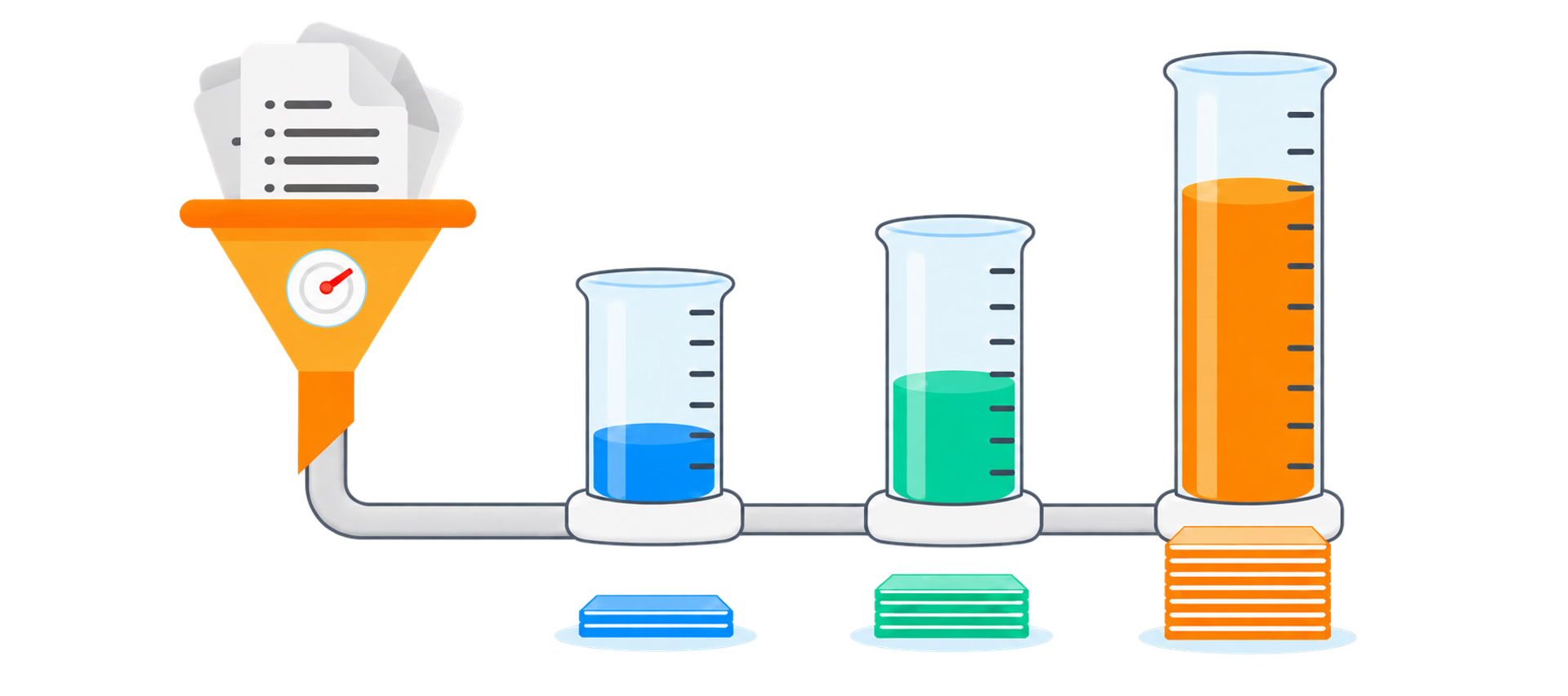
Ratio data is quantitative data measured in equal units with a meaningful true zero. Zero represents none of the quantity being measured, so both differences and ratios make sense. If one customer made 10 purchases and another made 5, it is meaningful to say the first made twice as many purchases. Common survey examples include purchase counts, time spent, distance travelled, exact age, and money spent.
Ratio data is numerical, but not every number is ratio data. A customer ID is a label, a satisfaction score is usually ordered rather than truly quantitative, and temperature in Celsius has no true zero. Identifying the measurement correctly helps you write better questions, preserve valid zero responses, and choose analysis methods that fit the data. For the complete process around cleaning, segmenting, interpreting, and reporting responses, begin with our survey results analysis guide.
Characteristics of ratio data
- The values measure a quantity. They represent an amount or count, not a category that happens to have a number as its label.
- The values have a meaningful order. Ten minutes is longer than five minutes, and four purchases are more than two.
- The units are equally spaced. The difference between 5 and 10 minutes is the same amount of time as the difference between 20 and 25 minutes.
- Zero is meaningful. Zero purchases means no purchases were made during the stated period. The sample does not need to contain a zero; zero only needs to be possible and meaningful on the scale.
- Ratios are interpretable. Twenty minutes is twice as long as ten minutes. This is the feature that separates ratio data from interval data.
- The variable can be discrete or continuous. Counts are discrete; measured amounts such as duration and distance are continuous, within the precision used to record them.
| What it answers | How many, how much, how long, how far, or how often? |
|---|---|
| Value order | Meaningful |
| Distance between values | Equal and measured in a stated unit |
| True zero | Yes; zero represents none of the measured quantity |
| Useful summaries | Valid count, mean, median, range, IQR, variance, standard deviation, and percentiles |
| Useful charts | Histogram, box plot, dot plot, or scatter plot |
| Statistical method | Depends on the question, outcome type, design, distribution, and assumptions |
Ratio-scale survey question examples
A ratio-scale survey question asks for an exact numerical response in a clear unit and reference period. These details help respondents give comparable answers and help analysts understand what each value means.
Examples of survey questions that collect ratio data
During the past 30 days, how many times did you use this feature? Whole-number count
During the past 30 days, how many times did you use this feature?
1 of 6- Data form
- Whole-number count
- Why it is ratio data
- Zero means no use; 10 uses are twice as many as 5.
How many minutes did your most recent support interaction last? Duration in minutes
How many minutes did your most recent support interaction last?
2 of 6- Data form
- Duration in minutes
- Why it is ratio data
- Equal time units and a meaningful zero.
Approximately how much did you spend on this category in the past 30 days? Exact amount in a named currency
Approximately how much did you spend on this category in the past 30 days?
3 of 6- Data form
- Exact amount in a named currency
- Why it is ratio data
- Zero means no spending during the period; monetary differences and ratios are meaningful.
How many items were included in your most recent order? Whole-number count
How many items were included in your most recent order?
4 of 6- Data form
- Whole-number count
- Why it is ratio data
- The scale has a meaningful zero even if routing means every observed order has at least one item.
How many kilometres did you travel to attend the event? Distance in kilometres
How many kilometres did you travel to attend the event?
5 of 6- Data form
- Distance in kilometres
- Why it is ratio data
- Equal distance units and a meaningful zero.
How many full years have you worked in this field? Elapsed time in completed years
How many full years have you worked in this field?
6 of 6- Data form
- Elapsed time in completed years
- Why it is ratio data
- Zero means no completed years; proportional comparisons are meaningful.
Exact age, spend, duration, and counts can be ratio data. Once you replace the exact response with ranges such as 18–24, €0–€49, or 1–3 visits, you collect ordinal categories instead. Grouping exact values later can be useful for reporting, but keeping the original values preserves more information for analysis.
How to design reliable ratio-data questions
- Name one exact quantity. Ask about purchases, minutes, kilometres, or another concept respondents can understand consistently.
- State the unit. Do not make analysts guess whether a duration is in minutes or hours, or which currency an amount uses.
- Give a reference period or event. “During the past 30 days” or “your most recent order” is clearer than “usually.”
- Decide whether decimals are valid. Purchases require whole numbers, while distance or duration may allow decimals. Avoid asking for more precision than respondents can recall.
- Separate zero from missing answers. Zero is data. “Don’t know,” “not applicable,” “prefer not to answer,” and a skipped question need separate codes.
- Use plausible validation carefully. A minimum, maximum, or numeric-only rule can prevent typing errors, but it must still allow every truthful answer.
- Respect sensitive information. Exact age, income, health measures, or spending can feel personal. Explain why the answer is needed, collect only the precision you will use, and offer a suitable opt-out where appropriate.
- Test before launch. A small pilot can reveal unclear units, unrealistic limits, and questions respondents cannot answer reliably.
SurveyLegend’s Number Box helps you request a numerical answer. The field format does not determine the measurement level by itself: the wording and the meaning of zero still decide whether the result is ratio data.
How to analyze ratio data step by step
- Confirm the variable. Check that values use equal units, zero is meaningful, and numeric-looking IDs or rating codes have not been mixed in.
- Clean without erasing valid information. Standardize units, identify impossible values, distinguish missing responses from zero, and investigate duplicates or unusual results. Preserve the raw data and document every correction.
- State the valid base. Report how many respondents were eligible, how many answered, how many were missing, and whether weights were used.
- Inspect the distribution. Look at the raw values and a histogram or box plot before relying on one average. Counts, spend, and time data are often right-skewed.
- Describe center and spread. Use the mean and standard deviation for the arithmetic summary, and the median, percentiles, and IQR when they make the typical response and skew clearer.
- Compare or model only when the research question requires it. Choose a test or model from the groups, repeated measurements, outcome type, sampling design, and assumptions.
- Interpret in context. Report units, practical size, uncertainty, and limitations. A small p-value does not prove that a difference is important or that one variable caused another.
Worked ratio-data analysis example
Imagine that ten respondents report how many times they used a product feature during the past 30 days: 0, 1, 1, 2, 2, 2, 3, 4, 5, and 10. This is discrete ratio data because it is a count with a meaningful zero.
Summary of feature-use counts for 10 respondents
Valid responses 10
Valid responses
1 of 6- Result
- 10
- Interpretation
- All ten values are included in this example.
Mean 3.0 uses
Mean
2 of 6- Result
- 3.0 uses
- Interpretation
- The total of 30 uses divided by 10 respondents.
Median and mode 2 uses and 2 uses
Median and mode
3 of 6- Result
- 2 uses and 2 uses
- Interpretation
- The middle and most frequent values are both below the mean.
Minimum, maximum, and range 0, 10, and 10 uses
Minimum, maximum, and range
4 of 6- Result
- 0, 10, and 10 uses
- Interpretation
- The responses extend from no use to 10 uses.
Q1, Q3, and IQR 1, 4, and 3 uses
Q1, Q3, and IQR
5 of 6- Result
- 1, 4, and 3 uses
- Interpretation
- The middle half of responses lies between 1 and 4 uses.
Sample variance and standard deviation 8.22 uses² and 2.87 uses
Sample variance and standard deviation
6 of 6- Result
- 8.22 uses² and 2.87 uses
- Interpretation
- Variance is in squared units; standard deviation returns the spread to the original unit.
The mean of 3.0 is mathematically correct, but the median of 2 better describes the middle response in this small right-skewed sample. Report both rather than hiding the shape behind one number. The value 10 deserves investigation, but it should not be deleted automatically: it may be a genuine highly engaged user. A histogram or dot plot would show the shape, while a box plot would make the center, spread, and potential outlier easy to inspect.
Charts and summary statistics for ratio data
- Histogram: shows the distribution’s center, spread, shape, gaps, and possible outliers. Use sensible bin widths and include the unit.
- Box plot: summarizes the median and quartiles and is helpful for comparing the distribution between groups. Do not assume every point beyond a whisker is an error.
- Dot plot: preserves individual values and works especially well for smaller samples.
- Scatter plot: shows the relationship between two numerical variables and can reveal non-linearity, clusters, and influential observations before correlation or regression.
The mean and variance use every value and can be sensitive to extremes. The median and IQR are more resistant to unusual values, so presenting both pairs can make skewed survey results easier to understand. The coefficient of variation compares the standard deviation with the mean, but it is only meaningful for ratio-scale values with a positive mean that is not close to zero.
Statistical tests for ratio data
Ratio data permits more mathematical operations than categorical data, but that does not make every test valid. Start with the research question and design, then check independence, distribution, outliers, sample size, model form, and variance assumptions.
Starting points for ratio-data analysis
What is typical, and how much do responses vary? Mean and SD; median and IQR
What is typical, and how much do responses vary?
1 of 8- Possible starting method
- Mean and SD; median and IQR
- Important consideration
- Inspect the full distribution and report the valid base.
Do two independent groups differ in their means? Welch’s two-sample t-test
Do two independent groups differ in their means?
2 of 8- Possible starting method
- Welch’s two-sample t-test
- Important consideration
- Check independence, group distributions, outliers, and the meaning of a mean difference.
Did the same respondents change over time? Paired t-test on within-person differences
Did the same respondents change over time?
3 of 8- Possible starting method
- Paired t-test on within-person differences
- Important consideration
- Responses must be matched correctly; inspect the distribution of the differences.
Do three or more independent groups differ? ANOVA or Welch ANOVA
Do three or more independent groups differ?
4 of 8- Possible starting method
- ANOVA or Welch ANOVA
- Important consideration
- Plan follow-up comparisons and account for multiple testing.
Are two numerical variables associated? Scatter plot and Pearson correlation
Are two numerical variables associated?
5 of 8- Possible starting method
- Scatter plot and Pearson correlation
- Important consideration
- Check linearity and influential points; correlation does not establish causation.
Does one or more variable predict a continuous outcome? Linear regression
Does one or more variable predict a continuous outcome?
6 of 8- Possible starting method
- Linear regression
- Important consideration
- Check model form, residuals, independence, influential values, and unequal variance.
Does one or more variable predict a count? Poisson or negative-binomial regression
Does one or more variable predict a count?
7 of 8- Possible starting method
- Poisson or negative-binomial regression
- Important consideration
- Counts have distributional features that an ordinary linear model may not handle well.
Does the sample use weights, clusters, or strata? Design-aware estimates and standard errors
Does the sample use weights, clusters, or strata?
8 of 8- Possible starting method
- Design-aware estimates and standard errors
- Important consideration
- Use methods that represent the actual sampling design.
Rank-based or robust methods may be useful when a planned model is a poor fit, but they answer their own statistical questions and should not be chosen by a “normal or not normal” rule alone. For high-impact decisions, formal research conclusions, or complex samples, involve a statistician before collecting the data so the survey and analysis plan work together.
Ratio data vs. interval data
Ratio and interval data both have ordered values and equal units. Only ratio data has a true zero, which makes proportional comparisons meaningful. Duration in minutes is ratio data, while a time of day is interval data. Exact age is ratio data, while a calendar year is interval data. Temperature measured in Celsius or Fahrenheit is interval data; thermodynamic temperature in kelvins is ratio data because its scale begins at absolute zero.
The word “zero” printed on a scale is not enough. A 0–10 satisfaction rating does not prove that satisfaction has equal units or a complete absence at zero. Likewise, a postal code, account number, or category code remains nominal data even though it uses digits. Learn more in the dedicated interval data guide.
Common ratio-data mistakes
- Assuming every numerical response or numbered category is ratio data.
- Calling age, spend, or duration ranges ratio data after collecting them as ordered bands.
- Treating a zero response as missing, or coding missing and not-applicable answers as zero.
- Mixing units, currencies, or reference periods without converting and documenting them.
- Reporting only a mean when a skewed distribution or unusual value changes the story.
- Deleting outliers automatically instead of checking whether they are errors or genuine cases.
- Using a bar chart of arbitrary bins when a histogram or dot plot would preserve more detail.
- Selecting a statistical test solely because the variable is ratio data.
- Checking only the raw outcome for normality instead of the assumptions of the planned model.
- Reporting a p-value without an effect size, confidence interval, unit, and practical meaning.
- Ignoring repeated responses, weights, clustering, stratification, or other design features.
- Interpreting association or prediction as proof that one variable caused another.
Analyzing ratio data with SurveyLegend
SurveyLegend’s Live Analytics gives you an immediate view of collected responses. For deeper calculations or modelling, you can export survey data to Google Sheets, Excel, or CSV and continue in the tool that fits your analysis plan. Keep the raw values, codebook, missing-value rules, and any unit conversions together so another person can reproduce what you did.
More about other data types
Ratio data is one of five survey data types covered in this guide collection. Continue with the guides below to identify and analyze the other variables in your survey.
Ratio data FAQs
What is ratio data?
Ratio data is quantitative data measured in equal units with a meaningful true zero. Zero represents none of the measured quantity, so differences and proportional comparisons such as “twice as many” are meaningful. Counts, duration, distance, and exact amounts are common examples.
What is an example of a ratio survey question?
“During the past 30 days, how many times did you use this feature?” collects ratio data when respondents enter an exact count. The values have equal units, and zero means the feature was not used during that period. If the answers are changed to ranges such as 0, 1–3, and 4–6, the collected categories are ordinal instead.
Why is a true zero important in ratio data?
A true zero means the measured quantity is absent. It makes proportional statements valid: 10 purchases are twice as many as 5 purchases. An observed dataset does not need to contain a zero; zero only needs to have a genuine meaning on the measurement scale.
How do you analyze ratio data?
First validate units, ranges, missing values, and unusual observations. Then report the valid response count, inspect the distribution, and calculate suitable summaries such as the mean, median, range, interquartile range, variance, or standard deviation. Use histograms, box plots, or scatter plots, and choose statistical tests from the research question, sampling design, outcome type, and assumptions.
Which statistical tests can be used for ratio data?
Common starting points include Welch’s t-test for two independent group means, a paired t-test for matched observations, ANOVA or Welch ANOVA for three or more groups, Pearson correlation for a linear association, and linear regression for a continuous outcome. Count outcomes may need Poisson or negative-binomial models. Every method has assumptions, so ratio measurement alone does not make a test appropriate.
What is the difference between ratio and interval data?
Both ratio and interval data have ordered values and equal units. Ratio data also has a meaningful true zero, so proportional comparisons are valid. Duration in minutes is ratio data, while clock time is interval data. Temperature in Celsius or Fahrenheit is interval data; thermodynamic temperature measured in kelvins is ratio data.
Are Likert scales or 0–10 ratings ratio data?
No, not simply because their choices use numbers or begin at zero. A zero satisfaction rating does not establish a total absence of the underlying feeling, and the distance between adjacent ratings is not proven equal. A single Likert-type item is ordinarily treated as ordinal data; other rating scales require a justified measurement plan.
Can ratio data be discrete or continuous?
Yes. Discrete ratio data consists of countable values, such as the number of purchases or support requests. Continuous ratio data can take any value within a measured range, subject to the precision of the instrument, such as duration, distance, weight, or an exact amount of money.
Ready to turn feedback into your superpower?
Start creating better feedback surveys with SurveyLegend, start today!