What Is Open-Ended Data?
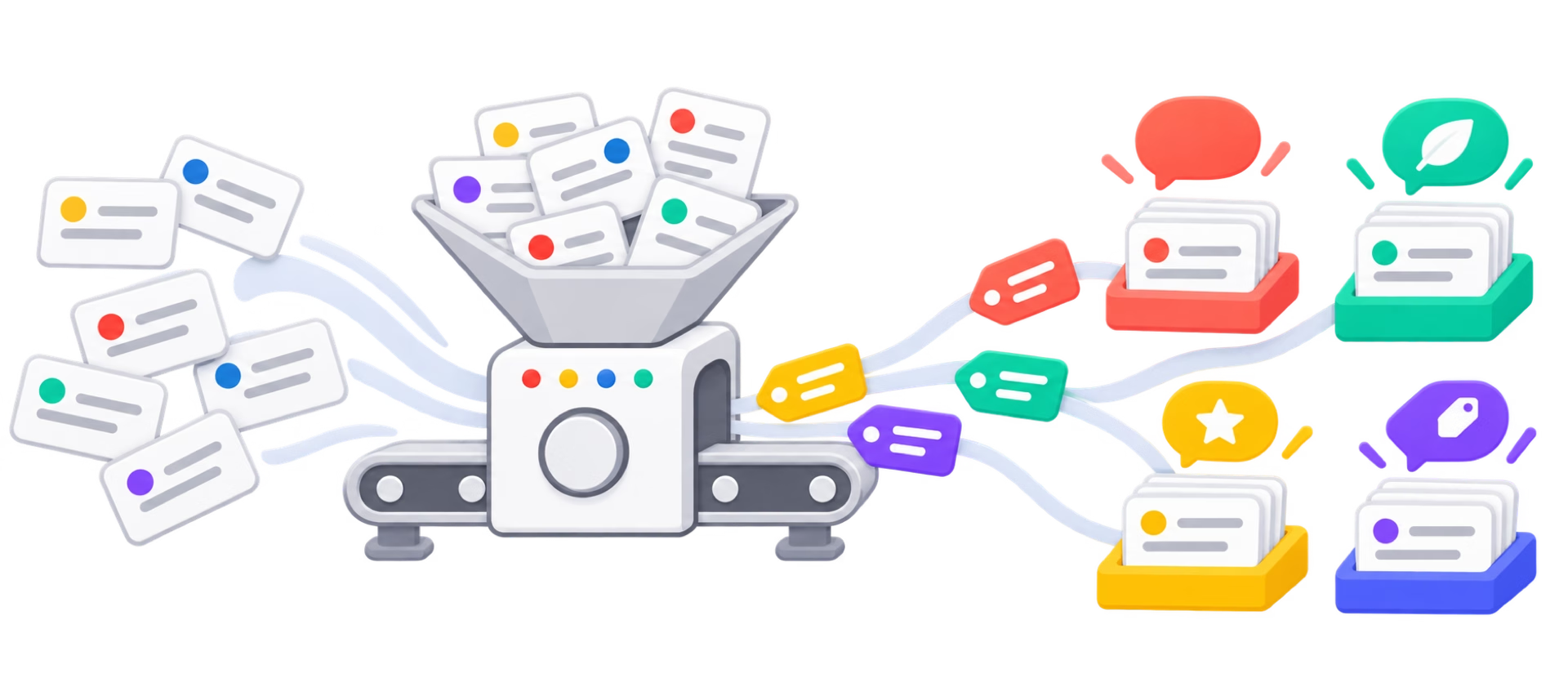
Open-ended data is information people provide in their own words instead of selecting from a list of predefined answers. In surveys, it is commonly collected through text boxes, comment fields, “Other” options, and follow-up questions such as “What could we do better?”
Open-ended survey data can contain opinions, experiences, explanations, suggestions, emotions, and details that ratings or multiple-choice answers may not capture. Because it is usually made up of written responses rather than fixed numerical values, it is generally treated as qualitative data.
The useful part is not simply that respondents can write more. Open-ended data lets people introduce ideas the questionnaire did not predict and explain why they selected a particular answer. That context can confirm, challenge, or completely change how you interpret the rest of the survey.
Open-ended questions, responses, and data
These terms are closely connected, but they describe different parts of the research process.
- An open-ended question does not restrict respondents to predefined answer choices.
- An open-ended response is the individual answer one respondent provides.
- Open-ended data is the collection of individual answers—or the dataset created from them—across a survey, interview, feedback form, or research project.
For example:
- Open-ended question
- “What could we do to improve your experience?”
- Open-ended response
- “The platform is easy to use, but I would like more options for customizing reports.”
- Open-ended data
- All the written answers collected from everyone who responded to that question.
The sequence is simple: you write an open-ended question, receive open-ended responses, and analyze the resulting open-ended data. If you are still designing the questionnaire, see our guide to open-ended survey questions.
What is an example of open-ended data?
Imagine that a customer rates a service three out of five and is then asked:
“What is the main reason for your rating?”
The customer responds:
“The support team was helpful, but it took two days to receive an answer.”
The rating gives you measurable, closed-ended data. The written response adds the reason behind it. One short answer can contain several signals at once:
Information contained in one open-ended response
Positive topic Helpful customer support
Positive topic
1 of 4- Example
- Helpful customer support
- What it helps you understand
- What worked well
Negative topic Slow response time
Negative topic
2 of 4- Example
- Slow response time
- What it helps you understand
- What caused frustration
Sentiment Mixed
Sentiment
3 of 4- Example
- Mixed
- What it helps you understand
- Why one overall positive or negative label may be misleading
Possible action Reduce the time required to answer support requests
Possible action
4 of 4- Example
- Reduce the time required to answer support requests
- What it helps you understand
- Where the feedback may lead to an operational decision
A single response may contain several topics, opinions, or issues. This is why open-ended data can reveal context that a score alone cannot provide—and why forcing every comment into one category can hide useful information.
Open-ended data vs. closed-ended data
The main difference is how respondents are allowed to answer.
Open-ended and closed-ended survey data compared
Answer format Respondents answer in their own words.
Answer format
1 of 7- Open-ended data
- Respondents answer in their own words.
- Closed-ended data
- Respondents select from predefined options.
Typical data type Mainly qualitative
Typical data type
2 of 7- Open-ended data
- Mainly qualitative
- Closed-ended data
- Structured categorical or numerical data
Best used for Understanding experiences, motivations, reasons, and unexpected ideas
Best used for
3 of 7- Open-ended data
- Understanding experiences, motivations, reasons, and unexpected ideas
- Closed-ended data
- Measuring ratings, choices, frequencies, and percentages
Example question “Why did you choose this rating?”
Example question
4 of 7- Open-ended data
- “Why did you choose this rating?”
- Closed-ended data
- “How satisfied are you on a scale of 1–5?”
Common analysis Coding, categorization, thematic analysis, and optional sentiment analysis
Common analysis
5 of 7- Open-ended data
- Coding, categorization, thematic analysis, and optional sentiment analysis
- Closed-ended data
- Counts, percentages, distributions, charts, and—when the scale permits—averages and statistical analysis
Main advantage Provides depth and context.
Main advantage
6 of 7- Open-ended data
- Provides depth and context.
- Closed-ended data
- Makes results easier to measure and compare.
Main challenge Requires more time and interpretation.
Main challenge
7 of 7- Open-ended data
- Requires more time and interpretation.
- Closed-ended data
- May miss answers that were not included as options.
Closed-ended data is effective for showing what happened or how often it happened. Open-ended data helps explain why it happened and what it meant to the respondent. Many useful surveys combine the two: a closed-ended question measures the result, while an open-ended follow-up provides context.
Is open-ended data qualitative or quantitative?
Open-ended survey data is primarily qualitative because it usually contains words, descriptions, experiences, and opinions. However, “open-ended” and “qualitative” are not perfect synonyms.
For example, “How many employees work at your company?” can use a field that accepts any number. The answer format is open-ended because no choices are provided, but the information collected is still quantitative. Open-ended describes the response format; qualitative and quantitative describe the nature of the data.
Qualitative responses can also become measurable through coding. If 200 customer comments are grouped into consistent topics, you might find that 48 respondents mention price, 35 mention ease of use, 27 request features, and 18 mention customer support. The original responses remain qualitative, while the codes create structured variables that can be counted and compared.
Counting should not replace reading. Two respondents may mention the same topic for different reasons, and one serious but uncommon problem can matter more than a frequently mentioned minor inconvenience. Read more about qualitative and quantitative surveys.
Is open-ended data structured or unstructured?
Free-text survey answers are generally described as unstructured or semi-structured. Respondents can use different words, sentence lengths, languages, and formats, even when they are answering the same question.
The surrounding survey record still provides structure. A response can have an ID, question label, submission date, rating, customer segment, or other variables. Coding adds another structured layer by turning repeated ideas into consistent categories. Keep the original text alongside those categories so you can return to the respondent’s meaning instead of relying only on counts.
Where does open-ended data come from?
Open-ended data can come from many places, including:
- Survey text boxes and comment fields
- “Other, please specify” answer options
- Customer feedback and suggestion forms
- Employee engagement surveys
- Interviews and focus groups
- Product and service reviews
- Customer support conversations
- Social media comments
- Patient, student, or event feedback
- Research notes and written observations
In a survey, open-ended data is most useful when you need an explanation that fixed choices cannot provide. A satisfaction question might be followed by “What is the main reason for your answer?” An employee survey might ask, “What is one change that would improve your working experience?” Clear, specific prompts usually produce more focused data than a broad request such as “Any comments?”
Why is open-ended data important?
Open-ended data helps organizations understand the meaning behind their results. It gives respondents room to raise issues, ideas, and experiences that the survey creator may not have anticipated.
It can help you:
- Understand why respondents selected a particular rating
- Discover problems that were not included in the survey
- Identify recurring customer, employee, or community concerns
- Capture the language people naturally use to describe an experience
- Recognize emerging themes and changing expectations
- Find suggestions for improving products, services, or processes
- Add context to numerical survey results
- Select de-identified quotations that accurately illustrate broader findings
Suppose a satisfaction score falls. Closed-ended results show the change; open-ended responses may reveal whether it relates to pricing, product quality, delivery, support, usability, or something the questionnaire did not measure. The comments do not merely add more information—they can change the interpretation of the score.
What are the challenges of open-ended data?
Open-ended data provides depth, but that flexibility creates practical and analytical challenges:
- Responses can vary greatly in length, detail, and relevance.
- Different respondents may use different words for the same issue.
- One response may contain several topics or mixed opinions.
- Manual review can be time-consuming when thousands of comments are collected.
- Coding decisions can be affected by the analyst’s assumptions and interpretation.
- Respondents may skip questions that feel vague, repetitive, or demanding.
- Free-text answers may contain personal, confidential, or sensitive information.
- Translation can change meaning when responses are collected in several languages.
Participation also deserves attention. Pew Research Center found that response rates to open-ended questions can differ across respondent groups and survey conditions. Check who answered, who skipped the question, and whether the available comments may underrepresent some perspectives before treating them as the voice of the whole sample.
Question wording affects data quality too. “What is one thing we could change to improve your experience?” gives clearer direction than “Any comments?” while still allowing respondents to answer in their own words.
How is open-ended data analyzed?
Open-ended data is normally analyzed by organizing responses into meaningful codes, topics, categories, or themes while preserving enough context to understand what respondents meant. A practical workflow is to:
- Preserve the original responses and create a protected working copy.
- Classify empty, irrelevant, duplicate, and substantive answers consistently.
- Read the responses before deciding on final categories.
- Create clear coding definitions with inclusion, exclusion, and uncertainty rules.
- Test the categories on a varied sample and refine them.
- Assign more than one code when a response contains several meaningful ideas.
- Count topics using a stated unit and denominator.
- Compare relevant respondent groups and closed-ended answers.
- Return to the original comments to interpret context, exceptions, and severity.
- Report evidence, limitations, and possible actions separately.
Use a codebook or content-analysis approach when you need consistent counts. Use thematic analysis when you need to interpret broader patterns of meaning. The approaches can complement each other, but they answer different questions.
Smaller datasets can often be analyzed manually. Larger datasets may use spreadsheets, qualitative research software, text search, natural-language processing, or AI-assisted tools. Automated results should still be validated against original responses, and sensitive text should only be handled in approved systems with suitable privacy and retention terms.
For multilingual responses, decide whether to code in the original language or after translation, document that choice, and have uncertain translations reviewed by someone who understands the language and context.
Word counts and word clouds can help you explore the data, but they are not a complete analysis. They often miss synonyms, negation, sarcasm, context, and mixed sentiment. The CDC Field Epidemiology Manual and Columbia University’s content-analysis overview provide useful introductions to systematic qualitative analysis. For the wider survey workflow, see how to analyze survey results.
Key takeaway
Open-ended data is the collection of unrestricted answers people provide in their own words. It gives you explanations, experiences, motivations, and context that fixed survey answers may miss.
Closed-ended data helps you measure results. Open-ended data helps you understand them. Many effective surveys use both, then connect each written response to the relevant ratings and respondent groups without losing the original meaning.
Continue with the other survey data guides
Open-ended text is often analyzed alongside nominal, ordinal, interval, and ratio data. Use these guides to identify and analyze the other variables connected to your comments.
Open-ended data FAQs
What is open-ended data in a survey?
Open-ended survey data is the information collected when respondents answer in their own words instead of choosing from predefined options. It commonly includes explanations, opinions, suggestions, experiences, and comments entered into text boxes or comment fields.
What is the difference between open-ended data and qualitative data?
Open-ended describes how an answer is collected: the respondent is not restricted to predefined choices. Qualitative describes the nature of the information, such as opinions, experiences, and descriptions. Most open-ended survey data is qualitative, but an unrestricted field can also collect a numerical answer.
Can open-ended data be measured?
Yes. Researchers can code responses into categories and count how many respondents mention each category. They may also develop themes to interpret broader patterns of meaning. Frequency alone does not show what respondents mean or how important an issue may be.
Is open-ended data structured or unstructured?
Free-text open-ended data is generally described as unstructured or semi-structured because respondents can use different words, lengths, and formats. Once responses are coded into consistent categories, those codes can form a structured dataset while the original text remains available for context.
What is the main benefit of open-ended data?
Its main benefit is that it helps explain the why behind a response. It gives people space to describe experiences, motivations, concerns, and ideas that the survey creator may not have anticipated when writing fixed answer options.
How is open-ended data analyzed?
A practical process is to preserve and clean the original responses, read the data, create and test coding categories, apply one or more codes where appropriate, count carefully defined topics, compare relevant groups, and return to the original comments when interpreting and reporting the findings.
Ready to turn feedback into your superpower?
Start creating better feedback surveys with SurveyLegend, start today!